AI customer service has moved from buzzword to business essential. From instant answers to always-on support and laser-precise personalization, intelligent tools, including AI in ITSM, are reshaping how companies interact with customers every day. Understanding why AI adoption matters for business growth is key for leaders who want to deliver faster, more consistent, and more satisfying service without endlessly adding headcount.
Beyond transforming customer support, AI is increasingly intertwined with advanced technologies that drive smarter business decisions. Cloud-based intelligent solutions for AI operations enable AI systems to process massive data in real time, supporting seamless interactions and predictive insights. Meanwhile, AI-enhanced digital marketing strategies allow businesses to personalize campaigns, forecast trends, and engage audiences with unprecedented precision.Marketing optimization with the help of AI in call centers ensures that campaigns are aligned with customer behavior insights, improving engagement and conversion rates. In the realm of finance, intelligent financial automation powered by AI helps organizations detect risks, automate reporting, and optimize investments efficiently. Even broader, cutting-edge computing innovations for AI workloads empower AI to handle complex workflows and scale customer service operations without adding unnecessary overhead. Together, these technologies show how integrated AI solutions are not only enhancing customer experience but also reshaping operations across marketing, finance, and IT infrastructure.
Top 10 AI Customer Service Software Platforms Transforming Support
When it comes to delivering faster, smarter, and more personalized customer experiences, AI-powered customer service platforms are leading the way. Here are the top 10 solutions helping businesses optimize support, reduce response times, and enhance satisfaction.
1. Bright Pattern – AI Customer Service Platform
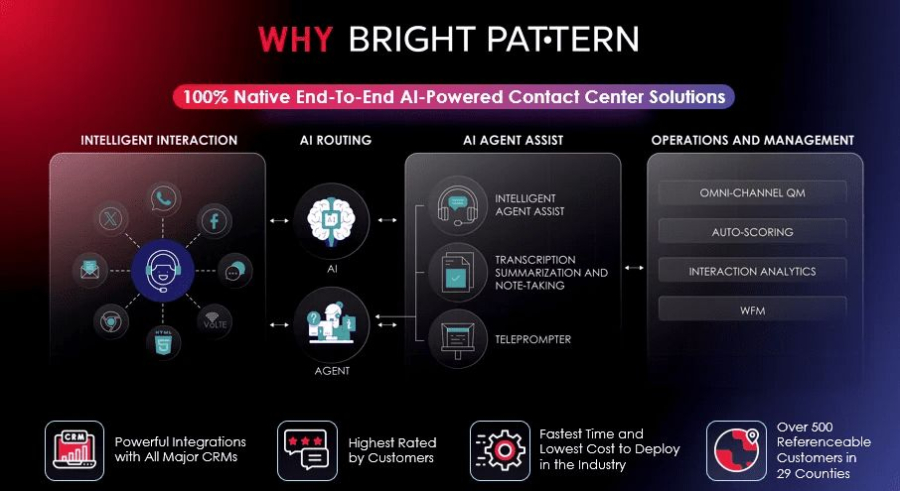
Bright Pattern stands out as a full-featured AI customer service solution trusted by global brands for its flexibility, scalability, and intelligent automation. It combines advanced AI capabilities with an intuitive interface to streamline customer interactions across multiple channels.
Key features include:
- Omnichannel support – handle voice, chat, email, SMS, and social media from a single interface.
- AI-driven agent assistance – real-time suggestions, call summaries, and predictive responses.
- Smart routing – ensure customers are connected to the right agent every time.
- Analytics and reporting – track KPIs, monitor agent performance, and optimize workflows.
- Cloud-based deployment – easy to scale without adding infrastructure.
Bright Pattern goes beyond traditional contact center solutions by integrating AI into every stage of the customer journey. Its intelligent automation helps reduce response times, resolve issues faster, and enhance overall customer satisfaction. Businesses also benefit from robust reporting and insights, enabling data-driven decisions that improve operations. With Bright Pattern, companies can create personalized, consistent experiences across all touchpoints while maintaining flexibility to adapt to changing customer needs.
2. Zendesk
A leading platform known for ticketing, chat, and AI-powered helpdesk automation.
3. Salesforce Service Cloud
Offers AI-driven insights, case management, and omnichannel support.
4. Genesys Cloud CX
Provides predictive routing, AI chatbots, and workforce optimization tools.
5. Freshdesk
Combines AI ticketing, automated workflows, and virtual agents for efficient customer support.
6. HubSpot Service Hub
Features AI-powered chat, ticket management, and customer feedback automation.
7. ServiceNow Customer Service Management
Offers AI-assisted workflows, predictive analytics, and enterprise-level automation.
8. LivePerson
Specializes in conversational AI for messaging, chatbots, and voice automation.
9. Five9
Cloud-based contact center software with AI-powered agent assistance and analytics.
10. RingCentral Contact Center
Provides AI-driven routing, analytics, and multi-channel support for customer service teams.
What Is AI Customer Service?
AI customer serviceuses artificial intelligence technologies to handle or assist customer support tasks. These tasks can include answering questions, routing tickets, detecting sentiment, suggesting responses, and even predicting customer needs before they are expressed.
Common AI components used in customer service include:
- Natural language processingto understand customer messages in everyday language.
- Machine learning modelsthat improve over time based on past interactions.
- Automation workflowsthat trigger actions like ticket creation, escalation, or follow-up messages.
- Recommendation enginesto suggest relevant help articles, next best actions, or products.
The result is a support experience that feels faster and more intuitive for customers, while giving human agents the time and tools they need to focus on high value conversations.
Core Benefits of AI in Customer Service
When implemented well, AI customer service delivers clear, measurable advantages for both customers and internal teams.
1. 24 / 7 availability without burning out your team
Customers expect help at any hour. With AI, you can provide instant responses around the clock, even when your human team is offline.
- Chatbots and virtual assistants handle common questions any time of day.
- Automated workflows acknowledge requests immediately, so customers never feel ignored.
- Self-service experiences stay open all the time, reducing wait times and frustration.
This always-on coverage significantly improves perceived responsiveness without requiring overnight staffing everywhere you operate.
2. Faster answers and reduced wait times
AI systems excel at retrieving and presenting the right information quickly. Instead of making customers wait in queues or dig through long FAQs, AI can:
- Instantly surface relevant help articles based on the customer’s question.
- Provide step-by-step troubleshooting guidance in real time.
- Quickly collect necessary details and route complex issues to the best human agent.
The experience feels effortless for customers and dramatically reduces the time it takes to resolve straightforward queries.
3. Consistent, high quality responses
Human agents have different levels of experience and knowledge, which can lead to inconsistent answers. AI tools help standardize and elevate the quality of responses by:
- Drawing from a single, vetted knowledge base.
- Applying the same logic and rules every time a similar question appears.
- Suggesting approved responses and templates to human agents in real time.
This consistency builds trust with customers and reduces the risk of miscommunication or policy errors.
4. Lower support costs with scalable automation
Many support teams are overwhelmed by repetitive questions. AI can take on a significant share of these routine tasks, enabling you to:
- Handle growing ticket volumes without scaling headcount at the same pace.
- Free human agents to focus on complex, relationship-building conversations.
- Reduce time spent on manual data entry, categorization, and routing.
Over time, this shift allows your support organization to do more with the same or even fewer resources, while still improving the overall customer experience.
5. Personalization at scale
Personalized service feels memorable, but it is hard to deliver consistently when you are handling thousands of interactions. AI makes personalization scalable by:
- Recognizing returning customers and referencing past conversations.
- Taking into account previous purchases, preferences, and behaviors.
- Adjusting tone and suggestions based on customer segment or journey stage.
The outcome is support that feels human and tailored, even when many steps are automated behind the scenes.
6. Actionable insights from every interaction
Customer conversations are full of valuable feedback, but it can be difficult for humans to analyze thousands of messages manually. AI helps you transform raw interactions into insights by:
- Tagging topics, issues, and product mentions at scale.
- Detecting trends in complaints or feature requests.
- Measuring sentiment across channels and over time.
These insights support better product decisions, more accurate staffing, and targeted improvements to the customer journey.
Common AI Customer Service Use Cases
AI can enhance almost every stage of the support journey. Below are some of the most impactful and widely adopted use cases.
1. AI chatbots and virtual assistants
AI chatbots are often the first touchpoint in modern customer service. They can:
- Answer frequently asked questions about orders, billing, or product features.
- Guide customers through standard processes, like resetting passwords.
- Collect key information before handing the conversation to a human agent.
Well designed chatbots feel conversational, use natural language, and are transparent about when they involve a human.
2. Intelligent knowledge base and self service
AI can turn a static knowledge base into a dynamic support experience. Instead of asking customers to search manually, AI engines:
- Interpret free form questions and map them to relevant help content.
- Suggest the most likely solutions based on similar past cases.
- Continuously learn which articles lead to successful resolutions.
This creates a self service experience that feels smart and intuitive, reducing the need for live support.
3. Automated ticket classification and routing
Support teams often spend time manually categorizing tickets and deciding who should handle them. AI can streamline this by:
- Analyzing the content of each incoming ticket or message.
- Assigning the right category, priority, and topic tags automatically.
- Routing issues to the most suitable team or agent based on expertise and workload.
The result is faster resolution times and more balanced workloads across your support team.
4. Agent assistance and response suggestions
AI is not only for customers; it can be a powerful co pilot for your human agents. In real time, AI can:
- Suggest relevant answers, snippets, or templates based on the conversation.
- Summarize long threads so agents can get up to speed quickly.
- Flag potential policy conflicts or compliance risks inside responses.
This support helps newer agents perform like experienced professionals and reduces cognitive load for everyone.
5. Sentiment analysis and quality monitoring
Understanding how customers feel is just as important as what they say. AI can analyze language and tone to:
- Detect when a customer is frustrated or at risk of churning.
- Trigger escalation workflows or offer proactive outreach.
- Monitor overall sentiment over time and across channels.
These insights allow supervisors to intervene early and continuously refine service quality.
6. Proactive customer support
Moving from reactive to proactive support is a major opportunity. AI helps you anticipate and prevent issues by:
- Identifying patterns that typically lead to support requests.
- Suggesting outreach before a problem becomes serious.
- Delivering personalized tips or reminders based on customer behavior.
Customers experience fewer disruptions and feel that your brand is genuinely invested in their success.
How AI Customer Service Works Behind the Scenes
While the customer experience may feel simple and seamless, a combination of technologies work together behind the scenes.
Key building blocks
- Natural language understandingto interpret intent, key entities, and context from messages.
- Dialogue managementto decide the next best step in a conversation, such as asking a clarifying question or fetching data.
- Integration with business systemssuch as customer relationship tools, order management platforms, and internal knowledge bases.
- Machine learning modelsthat learn from historical tickets, resolutions, and outcomes.
- Analytics and feedback loopsto track performance and continually improve.
The more your AI systems are connected to accurate data and feedback, the more powerful and reliable they become.
Human and AI working together
In practice, the most effective setups blend human judgment with AI efficiency. Common collaboration patterns include:
- AI as first line support, with seamless handoff to humans for complex or sensitive issues.
- AI as a co pilot, assisting human agents with suggestions and context while they remain in control.
- AI as a quality coach, analyzing conversations after the fact to highlight opportunities for improvement.
This hybrid approach ensures customers benefit from speed and empathy, while your team maintains oversight and control.
Steps to Implement AI Customer Service Successfully
Implementing AI in customer support is most effective when approached as a strategic initiative rather than a quick add on. The steps below provide a practical roadmap.
1. Define clear goals and success metrics
Start with the business and customer outcomes you want to achieve. For example, you might aim to:
- Reduce average response time on chat.
- Increase the percentage of customers using self service.
- Improve customer satisfaction for a specific product line.
- Lower the cost per resolved ticket.
These goals inform which AI capabilities to prioritize and how to measure impact.
2. Map customer journeys and identify high value use cases
Analyze your current support journeys and data. Look for:
- Frequently asked questions that are factual and repetitive.
- Processes that follow predictable, rule based steps.
- Channels with high volume and long wait times.
These are prime candidates for AI powered automation and assistance. Start with a few well defined use cases where you can quickly demonstrate value.
3. Prepare your knowledge and data
AI tools are only as good as the information behind them. Before or during implementation, focus on:
- Cleaning and updating your knowledge base with accurate, customer friendly content.
- Standardizing categories, tags, and resolution codes for tickets.
- Ensuring that customer profiles and history are reliable and accessible.
A strong data foundation directly improves AI response quality and reliability.
4. Choose the right AI solutions and integration approach
Different organizations need different levels of customization. When selecting AI tools, consider:
- How well the solution integrates with your existing customer service platforms.
- Whether it supports your key channels, such as web chat, email, social, or voice.
- The level of control you have over training data, tone, and workflows.
- Reporting capabilities that help track performance and outcomes.
Align your tool choice with your technical resources and long term roadmap.
5. Design conversations and workflows with care
AI interactions should feel natural and respectful. When designing conversations:
- Set clear expectations by indicating when customers are interacting with an AI system.
- Provide easy ways to reach a human when needed.
- Use concise language and avoid unnecessary technical jargon.
- Handle edge cases gracefully, including when the AI is unsure.
Thoughtful conversation design is a major factor in customer satisfaction.
6. Launch in phases and learn continuously
Instead of a big bang rollout, consider a phased approach:
- Start with a limited set of topics or a specific customer segment.
- Monitor performance, gather customer feedback, and refine.
- Gradually expand coverage and complexity as confidence grows.
AI systems improve over time, especially when you implement strong feedback loops and continuous training.
Best Practices for High Performing AI Customer Service
To unlock the full value of AI in customer support, it is important to follow proven practices that keep the experience customer centric.
Keep humans in the loop
Even advanced AI systems benefit from human oversight. Encourage your agents to:
- Review and refine AI suggested answers before sending, especially in sensitive cases.
- Flag incorrect or unclear AI responses for retraining.
- Provide feedback on conversation flows that seem confusing to customers.
This collaboration ensures AI remains aligned with your brand standards and customer expectations.
Be transparent with customers
Customers appreciate honesty. Make it clear when they are interacting with AI and when a human is joining the conversation. Transparency helps to:
- Build trust and set realistic expectations.
- Reduce frustration when AI cannot handle certain requests.
- Encourage customers to use self service because they understand what it can do.
Protect privacy and use data responsibly
AI customer service typically involves handling sensitive customer information. Ensure you:
- Limit data collection to what is necessary for support.
- Apply appropriate security controls to protect stored and transmitted data.
- Respect regional regulations and internal policies on data usage.
Responsible data practices strengthen long term relationships and reduce risk.
Measure what matters
Clear metrics help you demonstrate value and guide improvements. Useful measures include:
- Resolution ratefor AI handled conversations.
- Average response and resolution timesbefore and after AI implementation.
- Customer satisfaction scoresspecific to AI interactions.
- Agent productivity metrics, such as interactions handled per agent.
Tracking these indicators over time reveals where to invest further and where to refine.
Examples of Positive Outcomes with AI Customer Service
Organizations across industries are seeing tangible benefits from AI enhanced support. Common success patterns include:
- Retail and ecommercebrands using chatbots to answer order status and return questions, reducing pressure on live agents and speeding up responses.
- Software and technologyproviders offering intelligent in app help and tutorials, leading to smoother onboarding and fewer support tickets.
- Financial servicesfirms automating routine account questions while routing complex, high value conversations to specialists.
- Telecommunications and utilitiesusing AI to guide customers through troubleshooting steps, shortening outage related call times.
In each case, the combination of automation and thoughtful human escalation delivers both operational efficiency and a stronger customer experience.
Future Trends in AI Customer Service
AI is evolving quickly, bringing new possibilities for support teams. Some emerging trends include:
- More natural conversations, with AI systems that better understand nuance, context, and multi step requests.
- Deeper personalization, with AI tailoring interactions to each customer’s history and preferences.
- Multimodal support, combining text, voice, and visual guidance for richer assistance experiences.
- Stronger alignment with brand tone, as organizations fine tune AI to sound more like their own teams.
Adopting AI customer service today positions your organization to benefit from these advances as they mature.
Getting Started: Turning AI Customer Service into a Competitive Advantage
AI in customer service is no longer a distant future concept. It is a practical, powerful way to create faster, more personalized, and more reliable support experiences right now.
By starting with clear goals, focusing on high impact use cases, and designing AI systems that work in harmony with your human team, you can:
- Delight customers with quick, accurate answers.
- Empower agents to do their best work.
- Gain deep insights into customer needs and expectations.
- Build a support function that scales efficiently as your business grows.
With a thoughtful approach, AI customer service becomes more than a tool. It becomes a strategic advantage that strengthens loyalty, streamlines operations, and helps your brand stand out in a crowded marketplace.
